


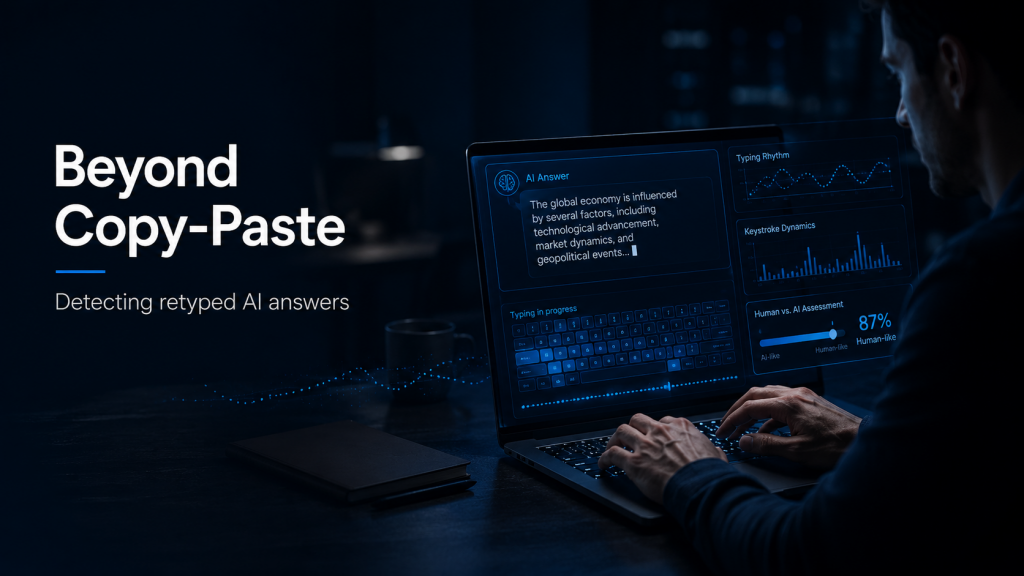
AI-generated answers are no longer always copied and pasted. Many applications block paste to prevent users from inserting AI-generated text directly.
But users can still read text from ChatGPT or another source on a phone or second screen, then manually retype it into a question box. No paste. No clipboard. No obvious plagiarism trail.
The words may be new, but typing behavior may still help estimate whether the text was composed naturally or retyped from another source.
We built a new integrity signal that focuses on that gap. It estimates whether text was typed naturally, or retyped from another source, using typing biometrics.
How does it work?
It is simple in concept: we look at typing behavior, not the words. When someone writes naturally, their rhythm changes as they think, revise, and correct themselves. When someone retypes from another screen, the flow often looks more like transcription.
Our model turns those behavioral patterns into a score that can be translated to a label, such as Copy, Unsure, or Not copy, so organizations can use it as an additional integrity signal without analyzing the content itself.
We trained and evaluated the model on thousands of sessions that included both natural writing and retyping. In our evaluation, the model reached over 90% accuracy at distinguishing the two in longer text scenarios with a baseline sample.
Why this matters beyond paste blocking and content analysis
Copy paste can be blocked. If a user reads an answer on a phone and retypes it into the answer box, paste blocking does not stop that behavior. Content analysis can still help, but it is probabilistic, can misclassify, and can be harder to rely on with paraphrasing, short answers, or careful edits.
Retype Detection sits on top of those layers. It does not judge what the text says. It looks at how the text was produced, and adds a behavioral signal that can bring more clarity when the words alone are not enough.
Retyping is different from writing
When people write genuinely, they are composing. They pause to think. They revise. They change pace mid-sentence. They correct themselves.
When people retype, they are often transcribing. They may not be generating the content in the same way, they may be copying it through the keyboard. That shift can show up in patterns like rhythm consistency, speed changes, pauses, and corrections.
This is not about judging the text. It is about how the text was produced.
Why this helps with AI-assisted integrity risks
This is not a generic AI content detector. It does not try to guess whether text “sounds like AI.”
Instead, it detects a common behavior pattern that often happens when AI is involved: retyping an answer from another screen to avoid paste detection.
That makes it useful in:
- course exams and quizzes with typed responses
- online assignments with short answer fields
- certification and training tests where integrity matters
It can also help outside education, anywhere typed input has value and incentives exist to transcribe rather than compose.
Accuracy
Accuracy improves with more typed text, and improves again when a short baseline is available. To collect a baseline, ask the user to type a short, fixed text shown in a box. They can only transcribe what they see, which gives you a clean baseline sample.
As you see in the table below, our solution reaches beyond 90% on essay-style content.
| Setup | Accuracy |
|---|---|
| Short text (200 chars) | 79% |
| Short + baseline | 82% |
| Long text (600 chars) | 86% |
| Long + baseline | 91% |
How to use it responsibly
Retype Detection should be used as an integrity signal, not as an automatic punishment or decision engine.
A predicted “Copy” result should be used to trigger additional review, a second prompt, a step-up check, or another appropriate verification process. It should not be used as the sole basis for grading, discipline, hiring, rejection, or other consequential decisions.
For best results, require enough text to make the signal meaningful. We recommend 400+ characters where possible.
Retype Detection is separate from TypingDNA’s authentication products. TypingDNA Authentication verifies whether a user matches their enrolled typing pattern. Retype Detection estimates whether typed content appears to have been composed naturally or retyped from another source. These are different products with different intended uses.
Important: Organizations should assess the legal and regulatory requirements that apply to their own use case before deployment. In particular, organizations in the EU, or organizations using the output in relation to persons located in the EU, should perform their own legal and EU AI Act assessment before using Retype Detection in education, recruitment, employment, certification, or other consequential contexts.
Private preview
Retype Detection is currently in private preview for select organizations, for demonstration and technical evaluation only.
Retype Detection is currently available only for demonstration, evaluation, and private-preview purposes. It is not currently offered for production use in the EU, or for use by EU organizations, without a separate legal and compliance review.
During the demo and private-preview phase, Retype Detection should not be used with real students, candidates, employees, or other individuals in a way that affects grading, discipline, hiring, employment, certification, access, eligibility, or any other consequential decision. Demo outputs are for technical evaluation only and should not be treated as determinations of misconduct, copying, cheating, or candidate integrity.
Any organization that wants to use Retype Detection in a live education, certification, recruitment, employment, or other consequential context must complete its own legal and regulatory assessment before deployment, including any applicable EU AI Act assessment.
If you’re interested, please contact us.