


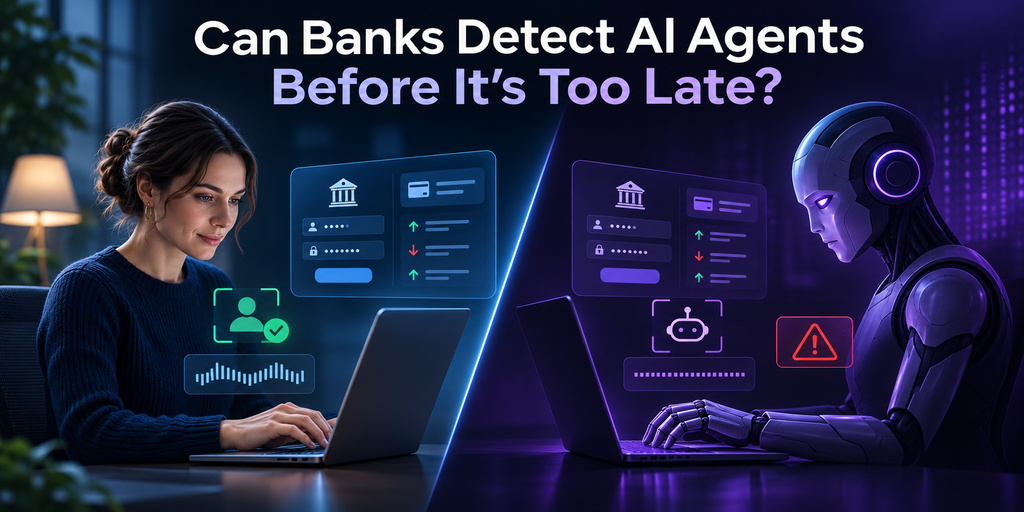
As AI agents begin operating inside customer bank accounts, typing biometrics could provide a missing layer of fraud protection.
The next fraudulent bank transaction might come from an AI agent using perfectly valid credentials. Would the bank notice before the money moves?
This is no longer a distant hypothetical.
In October 2026, Axios reported that major US banks, including JPMorgan Chase, Bank of America, Morgan Stanley, and Wells Fargo, were dealing with third-party AI agents accessing customer accounts, sometimes appearing to act beyond their users’ instructions.
Reuters subsequently reported that financial institutions were restricting or blocking some of these agents.
Many of these agents were initially granted access by customers themselves. But banks face a difficult problem: How can they distinguish a legitimate customer from an AI agent operating through the customer’s account? And how can they determine whether an agent’s actions are truly authorized?
A successful login doesn’t mean the customer is in control
Banks have sophisticated authentication and fraud detection systems. But passwords, authentication codes, and valid sessions don’t always reveal who is performing an action.
An attacker could obtain stolen credentials. A customer could give an AI agent access to their account. Or a compromised session could allow unauthorized activity without another login.
Now consider what happens when an account initiates an unusual transfer, adds a new beneficiary, changes payment details, or completes a sensitive financial application.
Wouldn’t it help to verify that the real customer is behind the action before approving it?
TypingDNA verifies the person, not the credentials
TypingDNA analyzes how people type, using behavioral characteristics such as the timing between keystrokes and individual typing patterns.
When a transaction or account action raises suspicion, a bank could request a short typing challenge and compare the customer’s typing pattern against their previously enrolled ones.
An AI agent – regardless if malicious or benevolent – might know the customer’s password. It might even have their 2FA code.
But stealing what someone knows is not the same as reproducing how they type.
This makes typing biometrics valuable far beyond login authentication. It can serve as an additional identity verification signal wherever banks need greater confidence that the legitimate customer is performing an action.
The concept also aligns with NIST SP 800-63B-4, which recognizes behavioral biometrics, including typing cadence, as potential signals for detecting fraud during authenticated sessions.
Human Likeness technology detects AI-driven interactions
But what if the challenge isn’t identifying a particular customer, but determining whether an interaction is human at all?
TypingDNA’s Human Likeness technology analyzes keyboard/typing interactions to help identify automated or synthetic typing behavior, without requiring an enrolled user profile.
This opens up additional fraud prevention opportunities.
Banks could use these signals in online applications, customer-service chats, sensitive forms, and other typed interactions where automated activity may indicate increased risk.
For example, a bank might flag suspicious automation during an account application or a sensitive customer-support interaction, while using typing biometric verification to confirm the identity of an enrolled customer before an unusual transaction.
Together, these technologies help answer two critical questions:
1. Is it human?
Human Likeness helps distinguish natural human typing from automated or synthetic input.
2. Is it the right human?
Typing biometrics authentication helps verify that the person typing matches the legitimate, enrolled account holder.
These are complementary risk signals, not guarantees against every AI agent or fraudulent transaction. They require appropriate integration into typing-based interactions and should work alongside existing fraud controls.
Fraud prevention in the age of AI must go beyond credentials
AI agents will become increasingly capable of interacting with banks, completing forms, communicating with customer support, and initiating financial actions. Some may be legitimate and useful. Others could be misused by attackers or operate beyond their intended permissions.
Banks must prepare for the worst.
The next frontier in fraud prevention isn’t just determining whether the credentials are correct. It’s understanding who, or what, is actually interacting with your platform. At TypingDNA, we’re helping financial institutions answer two questions that matter more than ever:
Is it human? And is it the right human?
Contact TypingDNA to explore how typing biometrics can strengthen your fraud prevention strategy.