


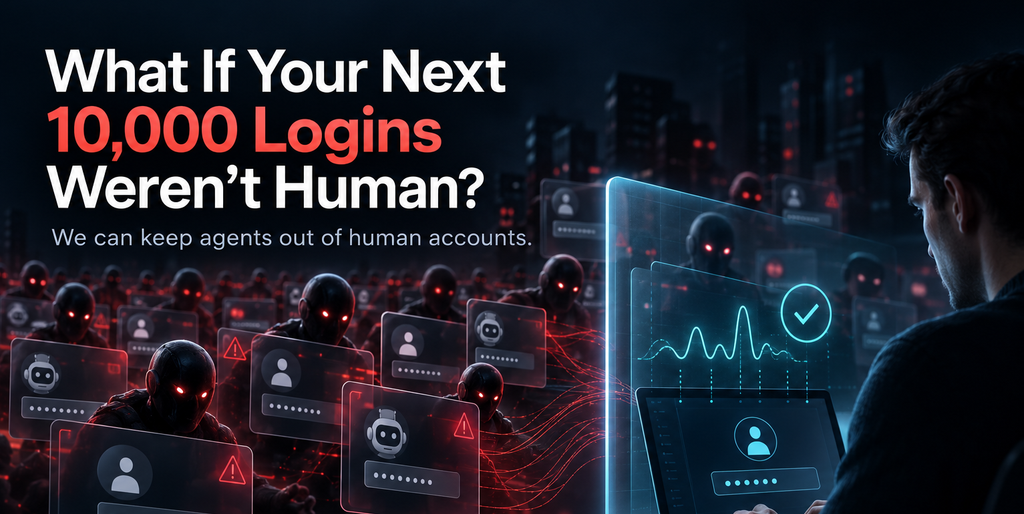
Imagine a swarm of AI agents logging into your platform tomorrow, using your real customers’ stolen credentials. Would your security team even notice?
AI agents are becoming increasingly capable of navigating websites, interacting with applications, and performing complex tasks autonomously.
That’s great when they’re programmed by you. But what happens when attackers use them to impersonate your users at scale?
With credentials stolen through breaches, phishing, or AI-assisted attacks, automated account takeovers could become faster and cheaper than ever. Even 2FA isn’t always enough when authentication codes or sessions are compromised.
Stealing what you know isn’t the same as being you.
A correct password doesn’t prove someone is human. And even a human-looking interaction doesn’t prove it’s the legitimate account owner.
TypingDNA helps platforms answer two critical questions:
1. Is it human?
Our Human Likeness technology analyzes typing behavior to help distinguish natural human interactions from automated or synthetic ones.
AI agents can generate text effortlessly. But, reproducing natural human typing behavior is a different challenge.
2. Is it the right human?
Our typing biometrics technology compares how someone types against the account owner’s enrolled typing patterns.
The technology comes in multiple flavors:
- Verify 2FA is an MFA method available for IAM platforms like Okta, MS Entra, Ping Identity, Keycloack
- SMS+ is a mobile typing challenge added before revealing the SMS OTP code
- Authentication API is meant for clients who want to add a custom typing biometrics verification to their desktop and/or mobile applications
An attacker might steal your password. They might even steal your 2FA code. But that doesn’t give them your typing behavior.
AI agents need their own door.
AI agents aren’t inherently a problem. In fact, we often want them to interact with our platforms and perform useful tasks.
But an AI agent should never need to impersonate a human user to do its job.
Agents should have their own identifiable access, explicitly granted permissions, and limited privileges. Their actions should be traceable, and their access independently revocable.
They shouldn’t simply reuse someone’s password, 2FA codes, or authenticated session.
Human accounts are for humans. Agents require agent accounts.
We Can Keep Agents Out of Human Accounts.
By combining Human Likeness detection with typing biometric verification, TypingDNA helps platforms detect automation and add another barrier against account takeover.
These are additional security layers, not guarantees against every attack.
AI agents are here to stay. We should embrace them, give them appropriate access, and benefit from their capabilities.
But let’s stop letting them through the same door as our human users.